
.
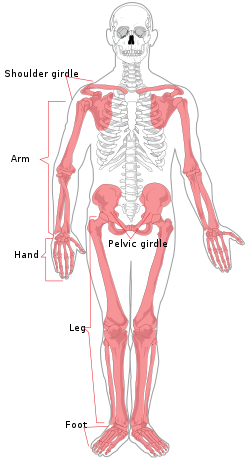
-126 BONES-
.
*6 GROUPS* —>
-PECTORAL GIRDLES-
-ARMS-
-HANDS-
-PELVIS-
-LEGS-
-FEET-
.
1
-4 BONES-
(2 [BONES] IN EACH [PEC])
2
-6 BONES-
(3 [BONES] IN EACH [ARM])
3
-54 BONES-
(27 [BONES] IN EACH [HAND])
4
-2 BONES-
(1 ON EACH SIDE OF BODY)
5
-8 BONES-
(4 [BONES] IN EACH [LEG])
6
-52 BONES–
(26 [BONES] IN EACH [FOOT])
.
4 + 6 + 54 + 2 + 8 + 52 =
126
.
-the appendicular skeleton is the portion of the skeleton of vertebrates consisting of the bones that support the ‘appendages’-
(‘appendages’ appeared as ‘fins’ in early fish, and subsequently evolved into the ‘limbs’ of ‘tetrapods’)
(the ‘appendicular skeleton’ includes the ‘skeletal elements’ within the ‘limbs’, as well as supporting ‘pectoral’ + ‘pelvic’ girdles in the case of ‘tetrapods’ (these are lacking in fish))
(the word ‘appendicular’ is the adjective of the noun appendage, which itself means “a part that is joined to something larger”)
.
.
.
*👨🔬🕵️♀️🙇♀️*SKETCHES*🙇♂️👩🔬🕵️♂️*
.
.
.
👈👈👈☜*“THE HUMAN SKELETAL SYSTEM”* ☞ 👉👉👉
.
.
💕💝💖💓🖤💙🖤💙🖤💙🖤❤️💚💛🧡❣️💞💔💘❣️🧡💛💚❤️🖤💜🖤💙🖤💙🖤💗💖💝💘
.
.
*🌈✨ *TABLE OF CONTENTS* ✨🌷*
.
.
🔥🔥🔥🔥🔥🔥*we won the war* 🔥🔥🔥🔥🔥🔥