
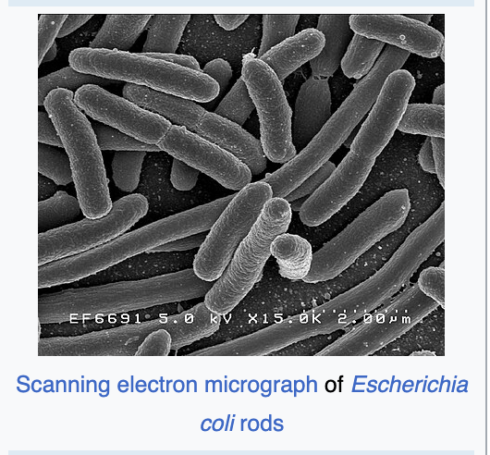
.
/bækˈtɪəriə/
‘common noun’ –> bacteria
‘singular’ –> bacterium
-[bacteria] are a type of [biological cell]-
(they constitute a large domain of ‘prokaryotic micro-organisms’)
(typically a few micrometers in length, bacteria have a number of ‘shapes’, ranging from ‘spheres’ to ‘rods’ to ‘spirals’)
(‘bacteria’ were among the first life forms to appear on ‘planet earth’, and are present in most of its habitats)
(‘bacteria’ inhabit…)
‘soil’
‘water’
‘acidic hot springs’
‘radioactive waste’
*the deep portions of ‘earth’s crust’*
.
(‘bacteria’ also live in ‘symbiotic’ + ‘parasitic’ relationships with ‘plants’ + ‘animals’)
(most bacteria have not been characterized, and only about 27% of the ‘bacterial phyla’ have species that can be grown in the ‘laboratory’ (specifically ‘unculturable phyla’ (known as ‘candidate phyla’) make up ‘103’ out of approximately ‘142 known phyla’))
(the study of bacteria is known as ‘bacteriology’)
(a branch of ‘microbiology’)
(virtually all ‘animal life’ on earth is dependent on ‘bacteria’ for their survival as only ‘bacteria’ (+ some ‘archea’) possess the ‘genes’ + ‘enzymes’ necessary to synthesize vitamin B12 (also known as ‘cobalamin’) + provide it through the ‘food chain’)
(‘vitamin B12‘ is a ‘water-soluble vitamin’ that is involved in the ‘metabolism’ of every ‘cell’ of the ‘human body’)
.
(‘bacteria’ is a ‘co-factor’ in…)
‘DNA synthesis’
‘fatty acid metabolism’
‘amino acid metabolism’
.
(it is particularly important in the normal functioning of the ‘nervous system’ via its role in the synthesis of ‘myelin’)
(there are typically ’40 million bacterial cells’ in a gram of ‘soil’ + ‘1 million bacterial cells’ in ‘1 milli-liter of ‘fresh water”)
(there are approximately 5×1030 bacteria on ‘earth’, forming a ‘biomass’ which exceeds that of all ‘plants’ + ‘animals’)
(‘bacteria’ are vital in many stages of the ‘nutrient cycle’ by recycling ‘nutrients’ (such as the fixation of ‘nitrogen” from the ‘atmosphere’)
(the ‘nutrient cycle’ includes the ‘de-composition’ of ‘dead bodies’)
(‘bacteria’ are responsible for the ‘putrefaction stage’ in this process)
(in the ‘biological communities’ surrounding ‘hydro-thermal vents’ + ‘cold seeps’, ‘extremophile bacteria’ provide the ‘nutrients’ needed to sustain ‘life’ by converting ‘dissolved compounds’ (such as ‘hydrogen sulphide’ + ‘methane’) to ‘energy’)
(data reported by researchers in ‘october 2012’ + published in ‘march 2013’ suggested that bacteria thrive in the ‘mariana trench’, which (with a depth of up to ’11 kilometers’, is the deepest known part of the ‘oceans’)
(other researchers reported related studies that ‘microbes’ thrive inside rocks up to ‘580 meters’ below the ‘sea floor’ under ‘2.6 kilometers’ of ‘ocean’ off the coast of the ‘northwestern united states’)
.
(according to 1 of the researchers…)
“you can find ‘microbes’ everywhere—they’re extremely adaptable to conditions + survive wherever they are”
‘researcher X’
(the famous notion that ‘bacterial cells’ in the ‘human body’ out-number ‘human cells’ by a factor of ’10:1′ has been debunked)
(there are approximately ’39 trillion bacterial cells’ in the ‘human microbiota’ (as personified by a “reference” 70 kg male 170 cm tall), whereas there are ’30 trillion human cells’ in the ‘body’)
(this means that although they do have the ‘upper hand’ in ‘actual numbers’, it is only by 30% (not 900%))
(the largest number exist in the ‘gut flora’, and a large number on the skin)
(the vast majority of the ‘bacteria’ in the body are rendered harmless by the ‘protective effects’ of the ‘immune system’…)
(….and many are beneficial, particularly in the ‘gut flora’)
(however, several species of ‘bacteria’ are ‘pathogenic’ + cause ‘infectious diseases’, including…)
‘cholera’
‘syphilis’
‘anthrax’
‘leprosy’
‘bubonic plague’
(the most common fatal ‘bacterial diseases’ are ‘respiratory infections’, with ‘tuberculosis’ alone killing about ‘2 million people’ per ‘year’, mostly in ‘sub-saharan africa’)
(in ‘developed countries’, ‘anti-biotics’ are used to treat ‘bacterial infections’ + are also used in ‘farming’, making ‘anti-biotic resistance’ a growing problem)
.
(in ‘industry’, ‘bacteria’ are important in…)
*’sewage treatment’ + the breakdown of ‘oil spills’*
*the production of ‘cheese’ + ‘yogurt’ via ‘fermentation’*
*the recovery of (‘gold’ / ‘palladium’ / ‘copper’) + other ‘metals’ in the ‘mining sector’*
*bio-technology*
*the manufacture of ‘antibiotics’ + other ‘chemicals’*
.
(once regarded as ‘plants’ constituting the class schizomycetes, ‘bacteria’ are now classified as ‘prokaryotes’)
(unlike cells of ‘animals’ + other ‘eukaryotes’, ‘bacterial cells’ do not contain a ‘nucleus’ and rarely harbor ‘membrane-bound organelles’)
(although the term bacteria traditionally included all ‘prokaryotes’, the ‘scientific classification’ changed after the discovery in the ‘1990s’ that ‘prokaryotes’ consist of 2 very different groups of ‘organisms’ that evolved from an ‘ancient common ancestor’)
(these ‘evolutionary domains’ are called bacteria + archaea)
.
.
.
*👨🔬🕵️♀️🙇♀️*SKETCHES*🙇♂️👩🔬🕵️♂️*
.
.
.
.
.
💕💝💖💓🖤💙🖤💙🖤💙🖤❤️💚💛🧡❣️💞💔💘❣️🧡💛💚❤️🖤💜🖤💙🖤💙🖤💗💖💝💘
.
.
*🌈✨ *TABLE OF CONTENTS* ✨🌷*
.
.
🔥🔥🔥🔥🔥🔥*we won the war* 🔥🔥🔥🔥🔥🔥