
.
-as of [6 APRIL 2026]-
.
-CUMULATIVE NATIONAL [DEBT/SURPLUS]-
([DEPARTMENT OF THE TREASURY] LINK)
.
*3 APRIL 2026* —>
-[$38,981,755,126,540.77]-
(LESS THAN [$39 TRILLION]-
.
“DEBT HELD BY THE PUBLIC”
-GOVERNMENT SELLS “TREASURY BONDS”-
.
“[INTRA-GOVERNMENTAL] HOLDINGS”
-WHEN A [PROGRAM] COLLECTS MORE IN TAXES THAN IT REQUIRES TO OPERATE AT THE MOMENT-
(SUCH AS “SOCIAL SECURITY”)
-THE EXTRA “TAX REVENUE” IS USED TO BUY ITS OWN [TREASURY BONDS]-
.

.
-WE HAD [NO DEBT] ON [8 JANUARY 1835]-
-ANDREW JACKSON-
.
-OFFICE OF [MANAGEMENT/BUDGET]-
.
.
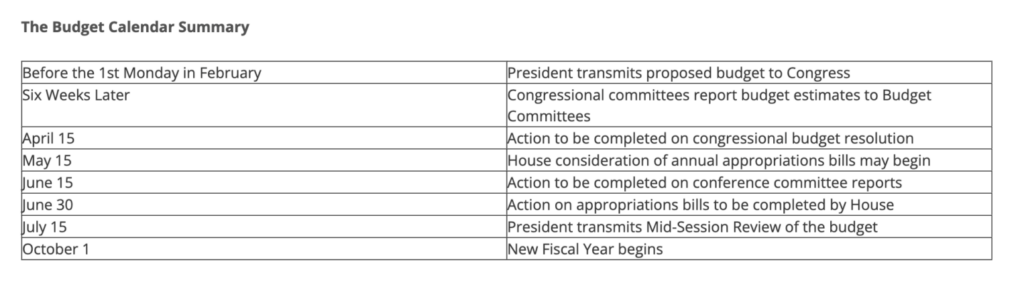
-1ST [MONDAY] OF [FEBRUARY]-
–[PRESIDENT] SUBMITS [BUDGET PROPOSAL] TO [CONGRESS]–
-1 FEBRUARY 2027-
.
-FEBRUARY 15TH-
-[CONGRESSIONAL BUDGET OFFICE] SUBMITS [ECONOMIC REPORT] TO [BUDGET COMMITTEES]-
-15 FEBRUARY 2027-
.
-APRIL 15TH-
-[CONGRESS] COMPLETES [BUDGET RESOLUTION]-
-15 APRIL 2026-
.
-JUNE 30TH-
-[HOUSE OF REPRESENTATIVES] PASSES 12 “APPROPRIATION BILLS”–
(NO DEADLINE FOR [SENATE] UNTIL BEGINNING OF NEXT [FISCAL YEAR])
(OCTOBER 1ST)
.
.
-BUDGET RESOLUTION-
(BLUEPRINT)
.
-HOUSE OF REPRESENTATIVES-
-simple majority-
(218 VOTES)
(OF 435)
.
-SENATE-
-simple majority-
(51 VOTES)
(OF 100)
(WHEN “50/50”, THE [VICE PRESIDENT] CASTS THE [DECIDING VOTE]-
“NO FILIBUSTERING!”
-[CONGRESSIONAL BUDGET ACT] OF 1974-
(CANNOT DELIBERATE OVER [50 HOURS])
-DOES NOT REQUIRE “PRESIDENTIAL APPROVAL”-
.
-APPROPRIATIONS BILL-
(THE CASHFLOW)
-HOUSE OF REPRESENTATIVES-
-simple majority-
(218 VOTES)
(OF 435)
.
-SENATE-
-FILIBUSTERING IS ALLOWED-
-SO IT REQUIRES [60 VOTES] TO PASS-
.
-THE PRESIDENT ONLY SIGNS THE [APPROPRIATIONS BILL]-
(HE HAS 10 DAYS TO SIGN IT)
(EXCLUDING “SUNDAY”)
.
-THE CONGRESS VOTES ON WHETHER TO OVERRIDE THE [VETO] SOMETIME BEFORE THE [2-YEAR] CONGRESSIONAL SESSION IS OVER-
-[2/3] MAJORITY REQUIRED IN BOTH [HOUSES]-
-ASSUMING ALL [SENATORS/REPS] ARE PRESENT AT THE VOTE* —>
-[290] REP VOTES-
-[67] SENATOR VOTES-
.
.
-HISTORY OF “BUDGET BALANCING”-
.
-the Budget of the United States Government often begins as the President’s proposal to the U.S. Congress which recommends funding levels for the next ‘fiscal year’-
.
(why is ‘fiscal year’ different?)
(do they collectively want to be different)
(lead normal boring lives)
(beginning October 1 and ending on September 30 of the year following)
(the “fiscal year” is named for the year in which it ends)
However, Congress is the body required by law to pass appropriations annually and to submit funding bills passed by both houses to the President for signature.
Congressional decisions are governed by rules and legislation regarding the federal budget process.
Budget committees set spending limits for the House and Senate committees and for Appropriations subcommittees, which then approve individual appropriations bills to allocate funding to various federal programs.
If Congress fails to pass an annual budget, a series of Appropriations bills must be passed as “stop gap” measures.
After Congress approves an appropriations bill, it is sent to the President, who may sign it into law, or may veto it (as he would a budget when passed by the ‘congress’)
A vetoed bill is sent back to Congress, which can pass it into law with a two-thirds majority in each chamber.
Congress may also combine all or some appropriations bills into an omnibus reconciliation bill.
In addition, the president may request and the Congress may pass supplemental appropriations bills or emergency supplemental appropriations bills.
Several government agencies provide budget data and analysis.
These include
the Government Accountability Office (GAO),
Congressional Budget Office,
the Office of Management and Budget (OMB)
and the U.S. Treasury Department.
.
These agencies have reported that the federal government is facing a series of important long-run financing challenges, primarily driven by an aging population, rising interest payments, and spending for healthcare programs such as Medicare and Medicaid
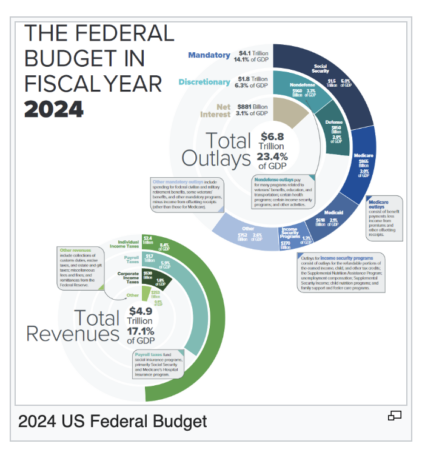
During fiscal year 2015, the Federal government received approximately $3.25 trillion in tax and fee revenue and had outlays (spending) of $3.7 trillion;
the difference was a $440 billion deficit.
Measured as a percentage of gross domestic product (a measure of the size of the economy), revenues were 18.2% GDP, well above the historical average (1980-2015) of 17.4% GDP.
Outlays of 20.7% GDP were slightly above the average of 20.6% GDP.
The deficit of 2.5% GDP was below the 3.2% GDP historical average.
After a significant increase primarily due to the Great Recession, the annual deficit returned to its historical average in fiscal year 2014 and is projected to remain around that level until 2019 before slowly rising.
President Donald Trump has proposed policies including significant tax cuts and increased spending on defense and infrastructure.
.
(the ‘committee for a responsible federal budget’ + ‘moody’s analytics’ reported in 2016 that enacting these policies would dramatically increase the annual budget deficits and national debt over the 2017-2026 periods, relative to the current policy baseline, which already includes a sizable ‘debt increase’)
.
.
.
*👨🔬🕵️♀️🙇♀️*SKETCHES*🙇♂️👩🔬🕵️♂️*
.
.
.
👈👈👈☜*“GOVERNMENT SPENDING”* ☞ 👉👉👉
.
.
💕💝💖💓🖤💙🖤💙🖤💙🖤❤️💚💛🧡❣️💞💔💘❣️🧡💛💚❤️🖤💜🖤💙🖤💙🖤💗💖💝💘
.
.
*🌈✨ *TABLE OF CONTENTS* ✨🌷*
.
.
🔥🔥🔥🔥🔥🔥*we won the war* 🔥🔥🔥🔥🔥🔥