
.
-as of [30 SEPTEMBER 2026]-
.
-[COMPOUND] PROFILE-
(TEMPLATE)
.
.
.
.
.
.
.
(or just compound if used in the context of ‘chemistry’)
-a (chemical) compound is an ‘entity’ consisting of 2 or more atoms, at least 2 from different elements, which associate via ‘chemical bonds’-
(there are 4 types of ‘compounds’, depending on how the constituent atoms are held together…)
‘molecules’
(held together by ‘covalent bonds’)
‘salts’
(held together by ‘ionic bonds’)
‘inter-metallic compounds’
(held together by ‘metallic bonds’)
‘certain complexes’ (name?)
(held together by ‘coordinate covalent bonds’)
(many ‘chemical compounds’ have a ‘unique numerical identifier’ assigned by the “chemical abstracts service” (CAS))
(aka – its “CAS number”)
(a “chemical formula” is a way of expressing information about the ‘proportions’ of ‘atoms’ that constitute a particular ‘chemical compound’, using the ‘standard abbreviations’ for the ‘chemical elements’, and ‘subscripts’ to indicate the # of ‘atoms’ involved)
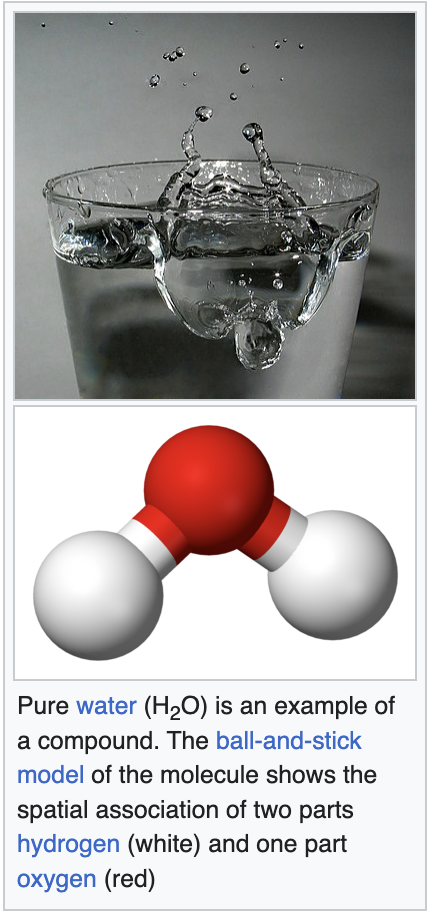
(for example, “water” is composed of 2 “hydrogen” atoms bonded to 1 “oxygen” atom…)
(so the chemical formula is H2O)
(a ‘compound’ can be converted to a different ‘chemical composition’ by interaction with a 2nd ‘chemical compound’ via a ‘chemical reaction’)
(in this process, ‘bonds’ between ‘atoms’ are ‘broken’ in both of the ‘interacting compounds’, and then ‘bonds’ are ‘reformed’ so that new associations are made between ‘atoms’)
(chematically, this reaction could be described as…)
AB + CD –> AC + BD
((A / B / C / D) are each ‘unique atoms’)
(‘AB’ / ‘CD’ / ‘AC’ / ‘BD’ are each ‘unique compounds’)
(a ‘chemical element’ bonded to an ‘identical chemical element’ is not a ‘chemical compound’ since only 1 element (not 2 different elements) is involved)
(examples are…)
*the ‘di-atomic molecule’ hydrogen (H2)*
*the ‘poly-atomic molecule’ sulfur (S8)*
.
.
.
*👨🔬🕵️♀️🙇♀️*SKETCHES*🙇♂️👩🔬🕵️♂️*
.
.
.
.
.
💕💝💖💓🖤💙🖤💙🖤💙🖤❤️💚💛🧡❣️💞💔💘❣️🧡💛💚❤️🖤💜🖤💙🖤💙🖤💗💖💝💘
.
.
*🌈✨ *TABLE OF CONTENTS* ✨🌷*
.
.
🔥🔥🔥🔥🔥🔥*we won the war* 🔥🔥🔥🔥🔥🔥