
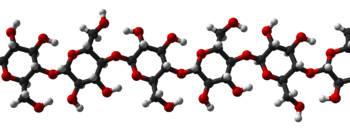
“cellulose”
.
/ˌpɒliˈsækəraɪd/
.
.
-“poly-saccharides” are ‘polymeric carbohydrate molecules’ composed of long chains of ‘monosaccharide units’ bound together by ‘glycosidic linkages’, and on ‘hydrolysis’ give the constituent ‘monosaccharides’ or ‘oligosaccharides’–
(they range in structure from ‘linear’ to ‘highly branched’)
(examples include ‘storage polysaccharides’ such as ‘starch’ and ‘glycogen’, and ‘structural polysaccharides’ such as ‘cellulose’ and ‘chitin’)
(‘polysaccharides’ are often quite ‘heterogeneous’, containing slight modifications of the repeating unit)
(depending on the structure, these ‘macromolecules’ can have distinct properties from their ‘monosaccharide building blocks’)
(they may be ‘amorphous’ or even ‘insoluble’ in water)
(when all the ‘monosaccharides’ in a ‘polysaccharide’ are the same type, the ‘polysaccharide’ is called a homopolysaccharide or homoglycan, but when more than 1 type of ‘monosaccharide’ is present they are called heteropolysaccharides or heteroglycans)
(‘natural saccharides’ are generally of ‘simple carbohydrates’ called ‘monosaccharides’ with general formula (CH2O)n where n is 3 or more)
(examples of ‘monosaccharides’ are ‘glucose’, ‘fructose’, and ‘glyceraldehyde’)
(‘polysaccharides’, meanwhile, have a general formula of Cx(H2O)y where x is usually a large number between ‘200’ and ‘2500’)
(when the ‘repeating units’ in the ‘polymer backbone’ are ‘6-carbon monosaccharides’, as is often the case, the general formula simplifies to (C6H10O5)n, where typically 40 ≤ n ≤ 3000)
(as a ‘rule of thumb’, ‘polysaccharides’ contain more than 10 ‘monosaccharide units’, whereas ‘oligosaccharides’ contain 3 to 10 monosaccharide units; but the precise cutoff varies somewhat according to ‘convention’)
(‘polysaccharides’ are an important class of ‘biological polymers’)
(their function in ‘living organisms’ is usually either ‘structure-‘ or ‘storage-‘ related)
(‘starch’ (a ‘polymer’ of ‘glucose’) is used as a ‘storage polysaccharide’ in ‘plants’, being found in the form of both ‘amylose’ and the branched ‘amylopectin’)
(in ‘animals’, the structurally similar ‘glucose polymer’ is the more densely branched ‘glycogen’, sometimes called “animal starch”)
(glycogen’s properties allow it to be ‘metabolized’ more quickly, which suits the active lives of ‘moving animals’)
(‘cellulose’ and ‘chitin’ are examples of ‘structural polysaccharides’)
(‘cellulose’ is used in the ‘cell walls’ of ‘plants’ and other ‘organisms’, and is said to be the most abundant organic molecule on ‘earth’)
(it has many uses such as a significant role in the ‘paper’ and ‘textile’ industries, and is used as a ‘feedstock’ for the production of ‘rayon’ (via the ‘viscose process’), ‘cellulose acetate’, ‘celluloid’, and ‘nitrocellulose’)
(‘chitin’ has a similar structure, but has ‘nitrogen-containing side branches’, increasing its ‘strength’)
(it is found in ‘arthropod exoskeletons’ and in the ‘cell walls’ of some ‘fungi’)
(it also has multiple uses, including ‘surgical threads’)
*’polysaccharides’ also include…*
‘callose’
(or ‘laminarin’)
‘chrysolaminarin’
‘xylan’
‘arabinoxylan’
‘mannan’
‘fucoidan’
‘galactomannan’
.
.
.
*👨🔬🕵️♀️🙇♀️*SKETCHES*🙇♂️👩🔬🕵️♂️*
.
.
.
.
.
💕💝💖💓🖤💙🖤💙🖤💙🖤❤️💚💛🧡❣️💞💔💘❣️🧡💛💚❤️🖤💜🖤💙🖤💙🖤💗💖💝💘
.
.
*🌈✨ *TABLE OF CONTENTS* ✨🌷*
.
.
🔥🔥🔥🔥🔥🔥🔥*we won the war* 🔥🔥🔥🔥🔥🔥🔥