
.
-as of [26 SEPTEMBER 2026]-
.
-31 DECEMBER 1994-
UTC+13:00 is an identifier for a time offset from UTC of +13:00
Because it does not contain any land in the Northern Hemisphere, this time zone is exclusive to the Southern Hemisphere.
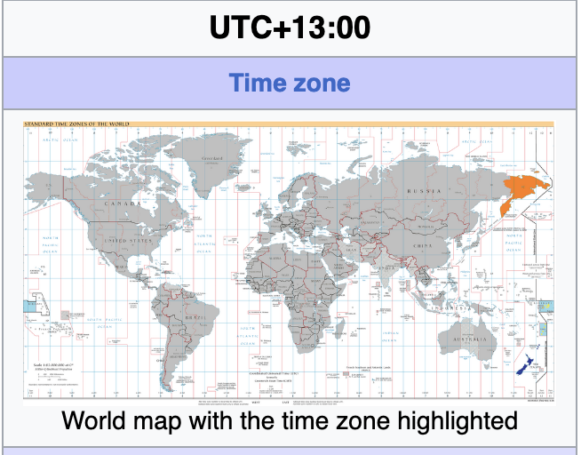
UTC+13:00: blue (December), orange (June), yellow (year-round), light blue (sea areas)
As standard time (year-round)
[edit]
Principal cities: Apia, Atafu, Nukuʻalofa
Kiribati
Phoenix Islands
New Zealand
Tokelau – Time in Tokelau[1]
Samoa – Time in Samoa[2][3][4]
Tonga – Time in Tonga
As daylight saving time (Southern Hemisphere summer)
[edit]
Principal cities: Auckland, Christchurch, Wellington
New Zealand (except Chatham Islands) – New Zealand Daylight Time
Some research bases in Antarctica, in particular the South Pole and the McMurdo Station. At New Year, these places are the first in the world to see the Sun, which is then visible at midnight.
Kiribati introduced a change for its eastern half on 31 December 1994, from time zones UTC−11:00 and UTC−10:00 to UTC+13:00 and UTC+14:00, to avoid having the country divided by the International Date Line.
Tonga has been on UTC+13:00 for many years. Daylight saving time was used in the southern summer seasons from October 1999 to January 2002, and from November 2016 to January 2017.[5]
UTC+13:00 was used until 2009 as a daylight time (summer in Northern Hemisphere) in the easternmost parts of Russia (Chukotka and Kamchatka) that used Kamchatka Time.
At the end of 29 December 2011 (UTC−10:00), Samoa advanced its standard time from UTC−11:00 to UTC+13:00 (and its daylight saving time from UTC−10:00 to UTC+14:00), essentially moving the international date line to the other side of the country, skipping 30 December 2011.[2][3] Following Samoa’s decision, Tokelau also simultaneously advanced its standard time (used without daylight saving time), from UTC−11:00 to UTC+13:00.[1][3]
Fiji, where normal time is UTC+12:00, decides year by year whether it will observe DST, and if so for which dates, which are usually a short period between November or December and January. No DST has been observed since 2020–2021.[6]
Time in Fiji
Time in New Zealand
Time in Russia
Time in Samoa
UTC−11:00, which is exactly one day behind UTC+13:00.
UTC−12:00, the last time zone to start a new day
^ Jump up to: a b “Tokelau: Wrong local time for over 100 years”. timeanddate.com.
^ Jump up to: a b McCabe, Joanne (May 9, 2011). “Samoa to change time zones and move forward by a day”. Metro. Archived from the original on December 28, 2012.
^ Jump up to: a b c “Samoa and Tokelau skip a day for dateline change”. BBC News. December 30, 2011. Archived from the original on December 10, 2014. Retrieved May 26, 2018.
^ “Daylight savings scrapped”. Samoa Observer. 20 September 2021. Retrieved 23 September 2021.
^ Clock Changes in Nukualofa, Tonga
^
“No DST Start in Fiji in 2021”. timeanddate. Retrieved 1 January 2024.
“Time Change 2025 in Fiji”. timeanddate. Retrieved 20 March 2025.
en.wikipedia.org
/wiki/UTC%2B13:00
UTC+13:00
Contributors to Wikimedia projects4-4 minutes 9/11/2005
From Wikipedia, the free encyclopedia
This article needs to be updated. The reason given is: Daylight saving time is no longer observed in Russia, hence the Kamchatka Time zone is now UTC+12 year-around. Please replace the image in Template:Infobox time zone/image. Please help update this article to reflect recent events or newly available information. (December 2024)
UTC+13:00
Time zone
World map with the time zone highlighted
UTC offset
UTC UTC+13:00
Current time
00:39, 25 June 2026 UTC+13:00 [refresh]
Central meridian
165 degrees W
.
.
.
*👨🔬🕵️♀️🙇♀️*SKETCHES*🙇♂️👩🔬🕵️♂️*
.
.
.
.
.
.
.
💕💝💖💓🖤💙🖤💙🖤💙🖤❤️💚💛🧡❣️💞💔💘❣️🧡💛💚❤️🖤💜🖤💙🖤💙🖤💗💖💝💘
.
.
*🌈✨ *TABLE OF CONTENTS* ✨🌷*
.
.
🔥🔥🔥🔥🔥🔥*we won the war* 🔥🔥🔥🔥🔥🔥