
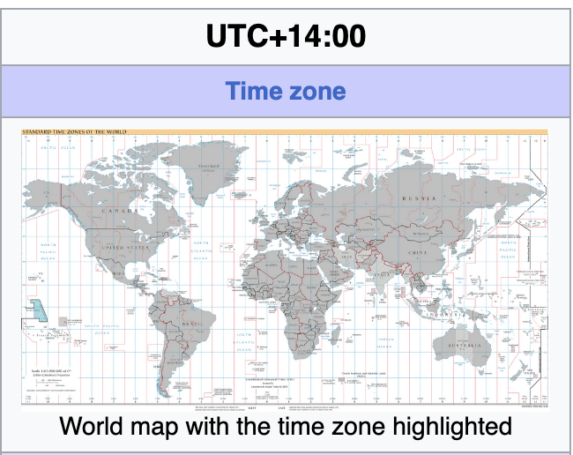
.
-as of [26 SEPTEMBER 2026]-
.
-31 DECEMBER 1994-
-THE [INTERNATIONAL DATE LINE] INITIALLY SPLIT [KIRIBATI] INTO 3 [TIME ZONES]-
-THE WESTERN [GILBERT ISLANDS] WAS [UTC+12]-
-THERE WERE NO “KIRIBATI ISLANDS” IN [UTC-12]-
-THE [PHOENIX ISLANDS] WERE IN [UTC-11]-
-THE [LINE ISLANDS] WERE IN [UTC-10]-
-[23-HOUR] TIM DIFFERENCE-
([GILBERT ISLANDS] – [PHOENIX ISLANDS])
-IF A [COUNTRY] WAS DIVIDED BY [INTERNATIONAL DATE LINE], IT WOULD HAVE A [24-HOUR] TIME DIFFERENCE BETWEEN [WEST/EAST]-
-THE [WEST] WOULD BE [1 DAY] AHEAD OF THE [EAST]-
-ON [31 DECEMBER 1994], THE [EASTERN] ISLANDS SKIPPED A DAY-
-THE [PHOENIX ISLANDS] BECAME [UTC+13]-
-THE [LINE ISLANDS] BECAME [UTC+14]-
-IN THE [LINE ISLANDS], [KIRITIMATI] IS THE EASTERNMOST ISLAND IN [UTC+14]-
-INHABITED BY [7000 PEOPLE]-
-[2200 KM] SOUTHWEST FROM [KIRITIMATI] TO [BAKER ISLAND]–
(WHICH IS [UTC-12])
(AND [26 HOURS] BEHIND [KIRITIMATI])
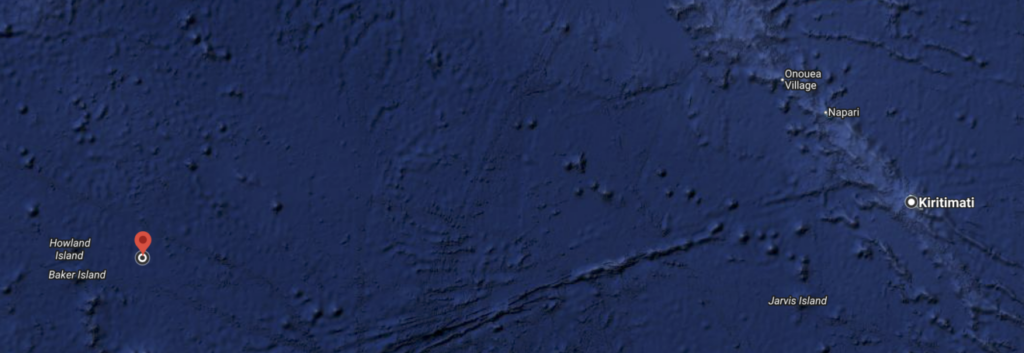
-THE LAST [INHABITED PLACE] TO START THE DAY IS [AMERICAN SAMOA] IN [UTC-11]-
UTC+14:00 is an identifier for a time offset from UTC of +14:00.
This is the earliest time zone on Earth, meaning that areas in this zone are the first to see a new day, and therefore the first to enter a New Year.
It is also referred to as the “latest time zone” on Earth, as clocks in it always show the ‘latest’ (i.e., most advanced) time of all time zones.
UTC+14:00 stretches as far as 30° east of the 180° longitude line and creates a large fold in the International Date Line around the Pacific nation of Kiribati.
As standard time (year-round)
[edit]
UTC+14:00: blue (December), orange (June), yellow (year-round), light blue (sea areas)
Principal settlement: Kiritimati
Kiribati
Line Islands
The central Pacific Republic of Kiribati introduced a change of date for its eastern half on 31 December 1994, from time zones UTC−11:00 and UTC−10:00 to UTC+13:00 and UTC+14:00.
Before this, the time zones UTC+13:00 and UTC+14:00 did not exist.
As a British colony, Kiribati was centred in the Gilbert Islands, just west of the old date line.
The distant Phoenix and Line Islands were on the other side of the date line.
Government offices on opposite sides of the line could only communicate by radio or telephone on the four days of the week when both sides experienced weekdays simultaneously.
The revision of Kiribati’s time zone meant that the date line in effect moved eastwards to go around this country, so that the Line Islands, including the inhabited Kiritimati island, started the year 2000 on its territory before any other country on Earth, a feature the Kiribati government capitalized on as a potential tourist draw.[1]
Tonga – IANA time zone database zone name Pacific/Tongatapu – used UTC+14:00 for daylight saving time from 1999 to 2002 and 2016 to 2017.[2] Therefore, Tonga celebrated new year 2000 at the same time as the Line Islands in Kiribati.
At the end of 29 December 2011 (UTC−10:00), Samoa advanced its standard time from UTC−11:00 to UTC+13:00 (and its daylight saving time from UTC−10:00 to UTC+14:00 until 4 April 2021), essentially moving the international date line to the other side of the country.[3][4]
Alaska had local times corresponding to between UTC+11:30 and UTC+15:10 until 1867 (24 hours were deducted in 1867 to make the date correspond to rest of United States). These times were local mean times and not time zones.
UTC+13:00 was used as a daylight time before 1982 in the parts of very eastern Russia (Chukotka) that used Kamchatka Time.[citation needed]
Time in Kiribati
Time in Alaska
Time in Russia
UTC−10:00, which is exactly one day behind UTC+14:00.
UTC−12:00, the last time zone to start a new day
^ Ariel, Avraham; Berger, Nora Ariel (2005). Plotting the Globe: Stories of Meridians, Parallels, and the International Date Line. Greenwood Press. p. 149. ISBN 0-275-98895-3.
^ “Daylight Saving Time Changes 1999 in Nukualofa, Tonga”. www.timeanddate.com.
^ “Samoa to change time zones and move forward by a day”. Metro. 9 May 2011. Archived from the original on 28 December 2012. Retrieved 9 May 2011.
^ “Samoa to move the International Dateline”. Herald Sun.
Find cities currently in UTC+14
en.wikipedia.org
/wiki/UTC%2B14:00
UTC+14:00
Contributors to Wikimedia projects4-4 minutes 9/11/2005
From Wikipedia, the free encyclopedia
UTC+14:00
Time zone
World map with the time zone highlighted
UTC offset
UTC UTC+14:00
Current time
05:59, 25 June 2026 UTC+14:00 [refresh]
Central meridian
150 degrees W
.
.
.
.
-TOP-
.
XXX
.
.
-SECTION 1-
-SECTION 2-
-SECTION 3-
.
.
-section1start-
-SECTION 1-
X
.
-section2start-
-SECTION 2-
X
.
-section3start-
-SECTION 3-
X
.
-groundzero-
.
X
-SECTION 3-
-section3end-
.
X
-SECTION 2-
-section2end-
.
X
-SECTION 1-
-section1end-
.
.
XXX
.
-BOTTOM-
.
-SF1 TOP-
(TEMPLATE)
-SF1 BOTTOM-
(TEMPLATE)
.
.
.
*👨🔬🕵️♀️🙇♀️*SKETCHES*🙇♂️👩🔬🕵️♂️*
.
.
.
.
*-INTERNATIONAL DATE LINE-* ☞ 👉👉👉
.
.
.
.
💕💝💖💓🖤💙🖤💙🖤💙🖤❤️💚💛🧡❣️💞💔💘❣️🧡💛💚❤️🖤💜🖤💙🖤💙🖤💗💖💝💘
.
.
*🌈✨ *TABLE OF CONTENTS* ✨🌷*
.
.
🔥🔥🔥🔥🔥🔥*we won the war* 🔥🔥🔥🔥🔥🔥
X
X