
.
-as of [27 JULY 2026]-
.
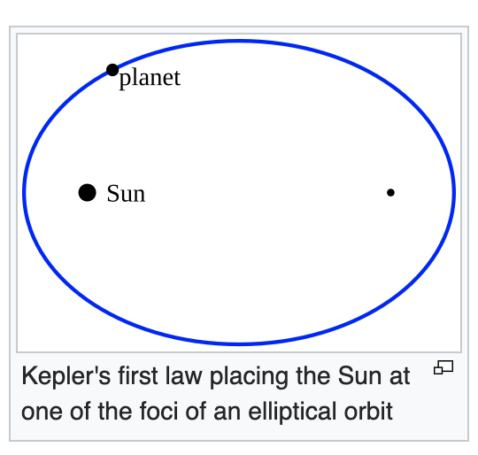
Kepler’s first law states that:[22]: 3
The orbit of every planet is an ellipse with the sun at one of the two foci
Kepler’s first law placing the Sun at one of the foci of an elliptical orbit
Heliocentric coordinate system (r, θ) for ellipse. Also shown are: semi-major axis a, semi-minor axis b and semi-latus rectum p; center of ellipse and its two foci marked by large dots. For θ = 0°, r = rmin and for θ = 180°, r = rmax.
Mathematically, an ellipse can be represented by the formula {\displaystyle r={\frac {p}{1+\varepsilon \cos \theta }},} where {\displaystyle p} is the semi-latus rectum, ε is the eccentricity of the ellipse, r is the distance from the Sun to the planet, and θ is the angle to the planet’s current position from its closest approach, as seen from the Sun. So (r, θ) are polar coordinates.
For an ellipse, 0 < ε < 1; in the limiting case ε = 0, the orbit is a circle with the Sun at the centre (i.e. where there is zero eccentricity).
At θ = 0°, perihelion, the distance is minimal: {\displaystyle r_{\text{min}}={\frac {p}{1+\varepsilon }}.}
At θ = 90° and at θ = 270°, the distance is equal to {\displaystyle p}.
At θ = 180°, aphelion, the distance is maximal (by definition, aphelion is – invariably – perihelion plus 180°): {\displaystyle r_{\text{max}}={\frac {p}{1-\varepsilon }}.}
The semi-major axis a is the arithmetic mean between rmin and rmax: {\displaystyle {\begin{aligned}a&={\frac {r_{\text{max}}+r_{\text{min}}}{2}},\a&={\frac {p}{1-\varepsilon ^{2}}}.\end{aligned}}}
The semi-minor axis b is the geometric mean between rmin and rmax: {\displaystyle {\begin{aligned}b&={\sqrt {r_{\text{max}}r_{\text{min}}}},\b&={\frac {p}{\sqrt {1-\varepsilon ^{2}}}}.\end{aligned}}}
The semi-latus rectum p is the harmonic mean between rmin and rmax: {\displaystyle {\begin{aligned}p&=\left({\frac {r_{\text{max}}^{-1}+r_{\text{min}}^{-1}}{2}}\right)^{-1},\pa&=r_{\text{max}}r_{\text{min}}=b^{2}.\end{aligned}}}
The eccentricity ε is the coefficient of variation between rmin and rmax: {\displaystyle \varepsilon ={\frac {r_{\text{max}}-r_{\text{min}}}{r_{\text{max}}+r_{\text{min}}}}.}
The area of the ellipse is {\displaystyle A=\pi ab.}
The special case of a circle is ε = 0, resulting in r = p = rmin = rmax = a = b and A = πr2.
.
.
.
*👨🔬🕵️♀️🙇♀️*SKETCHES*🙇♂️👩🔬🕵️♂️*
.
.
.
.
👈👈👈☜*-3 [LAWS] OF [PLANETARY MOTION]-* ☞ 👉👉👉
.
.
💕💝💖💓🖤💙🖤💙🖤💙🖤❤️💚💛🧡❣️💞💔💘❣️🧡💛💚❤️🖤💜🖤💙🖤💙🖤💗💖💝💘
.
.
*🌈✨ *TABLE OF CONTENTS* ✨🌷*
.
.
🔥🔥🔥🔥🔥🔥*we won the war* 🔥🔥🔥🔥🔥🔥