
.
-as of [27 JULY 2026]-
.
Kepler’s second law states that
-A line joining a planet and the Sun sweeps out equal areas during equal intervals of time-
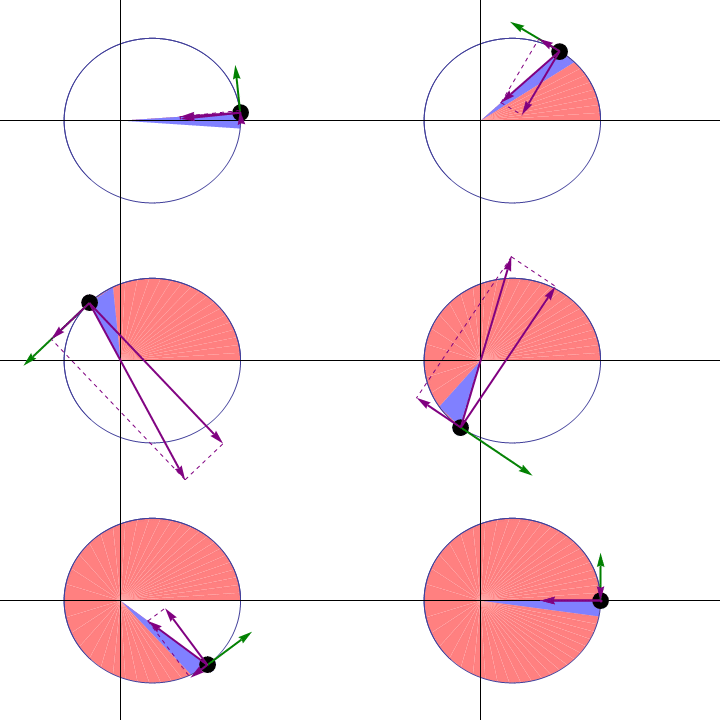
The same (blue) area is swept out in a fixed time period. The green arrow is velocity. The purple arrow directed towards the Sun is the acceleration. The other two purple arrows are acceleration components parallel and perpendicular to the velocity.
The orbital radius and angular velocity of the planet in the elliptical orbit will vary. This is shown in the animation: the planet travels faster when closer to the Sun, then slower when farther from the Sun. Kepler’s second law states that the blue sector has constant area.
Kepler notably arrived at this law through assumptions that were either only approximately true or outright false and can be outlined as follows:
Planets are pushed around the Sun by a force from the Sun. This false assumption relies on incorrect Aristotelian physics that an object needs to be pushed to maintain motion.
The propelling force from the Sun is inversely proportional to the distance from the Sun. Kepler reasoned this, believing that gravity spreading in three dimensions would be a waste, since the planets inhabited a plane. Thus, an inverse instead of the [correct] inverse square law.
Because Kepler believed that force would be proportional to velocity, it followed from statements #1 and #2 that velocity would be inverse to the distance from the sun. That force is proportional to velocity is an incorrect tenet of Aristotelian physics, but the errors of assumption in statements #2 and #3 essentially cancel, so that it is approximately true that velocity is inverse to the distance from the sun.
Since velocity is inverse to time, the distance from the sun would be proportional to the time to cover a small piece of the orbit. This is approximately true for elliptical orbits.
The area swept out is proportional to the overall time. This is also approximately true.
The orbits of a planet are circular (Kepler discovered his second law before his first law, which contradicts this).
Nevertheless, the result of the second law is exactly true, as it is logically equivalent to the conservation of angular momentum, which is true for any body experiencing a radially symmetric force.[24] A correct proof can be shown through this. Since the cross product of two vectors gives the area of a parallelogram possessing sides of those vectors, the triangular area dA swept out in a short period of time is given by half the cross product of the r and dx vectors, for some short piece of the orbit, dx: {\displaystyle dA={\frac {1}{2}}({\vec {r}}\times {\vec {dx}})={\frac {1}{2}}({\vec {r}}\times {\vec {v}}\,dt)} for a small piece of the orbit dx and time to cover it dt. Thus {\displaystyle {\frac {dA}{dt}}={\frac {1}{2}}({\vec {r}}\times {\vec {v}})={\frac {dA}{dt}}={\frac {({\vec {r}}\times {\vec {p}})}{2m}}.} Since the final expression is proportional to the total angular momentum {\displaystyle ({\vec {r}}\times {\vec {p}})}, Kepler’s equal area law will hold for any system that conserves angular momentum. Since any radial force will produce no torque on the planet’s motion, angular momentum will be conserved.
In terms of elliptical parameters
[edit]
In a small time {\displaystyle dt} the planet sweeps out a small triangle having base line {\displaystyle r} and height {\displaystyle r\,d\theta } and area {\displaystyle dA={\tfrac {1}{2}}\cdot r\cdot r\,d\theta }, so the constant areal velocity is {\displaystyle {\frac {dA}{dt}}={\frac {r^{2}}{2}}{\frac {d\theta }{dt}}.}
The area enclosed by the elliptical orbit is {\displaystyle \pi ab}. So the period {\displaystyle T} satisfies {\displaystyle T\cdot {\frac {r^{2}}{2}}{\frac {d\theta }{dt}}=\pi ab,} and the mean motion of the planet around the Sun {\displaystyle n={\frac {2\pi }{T}}} satisfies {\displaystyle r^{2}\,d\theta =abn\,dt.} And so, {\displaystyle {\frac {dA}{dt}}={\frac {abn}{2}}={\frac {\pi ab}{T}}.}
In the following example animations, the red ray rotates at a constant angular velocity and with the same orbital time period as the planet, {\displaystyle T=1}. S: Sun at the primary focus, C: Centre of ellipse, S′: The secondary focus. In each case, the area of all sectors depicted is identical.
Orbits of planets with varying eccentricities
Low ε High ε
Planet orbiting the Sun in a circular orbit (ε = 0.0)
Planet orbiting the Sun in an orbit with ε = 0.5
Planet orbiting the Sun in an orbit with ε = 0.2
Planet orbiting the Sun in an orbit with ε = 0.8
.
.
.
*👨🔬🕵️♀️🙇♀️*SKETCHES*🙇♂️👩🔬🕵️♂️*
.
.
.
.
.
👈👈👈☜*-3 [LAWS] OF [PLANETARY MOTION]-* ☞ 👉👉👉
.
.
💕💝💖💓🖤💙🖤💙🖤💙🖤❤️💚💛🧡❣️💞💔💘❣️🧡💛💚❤️🖤💜🖤💙🖤💙🖤💗💖💝💘
.
.
*🌈✨ *TABLE OF CONTENTS* ✨🌷*
.
.
🔥🔥🔥🔥🔥🔥*we won the war* 🔥🔥🔥🔥🔥🔥